News · Waikato
Project: Forgotten Generation — investigating homelessness in the Waikato
6 October 2026 · 3 min read
News · Opinion · What's On
National's campaign chair acknowledges a tight race after the party's worst poll result since 2020, while the Greens and ACT celebrate gains.
National's campaign chair Simeon Brown is acknowledging little more than that the election will be a tight one, off the back of a crushing poll result.
National plunged to 25.9 percent in the latest RNZ-Reid Research poll — its worst result since the brutal 2020 election defeat — while Labour took a smaller tumble, to 30.8 percent. The Greens soared to 14.8 percent, and once again Opportunity is kingmaker at 5.5 percent, with both the left and right blocs needing it to govern.
National leader Christopher Luxon did not wish to comment on the poll, so RNZ interviewed campaign chair Simeon Brown, who did not offer an explanation for why the party was in the doldrums. “I think what this poll overall shows is that the election is going to be very close, and that there's a lot of work to do between now and the 7th of November,” he said. “That's what we're focused on doing as the National Party.”
The poll also showed the country has been unable to shake its glum mood, with more than half of respondents saying New Zealand is going in the wrong direction under the current government. Brown said it had been a challenging time for New Zealanders, but the coalition had brought down inflation and restored law and order. “Our job over the next 33 or 32 days is to talk to New Zealanders about our plan and say party vote National to keep New Zealand moving in the right direction,” he said.
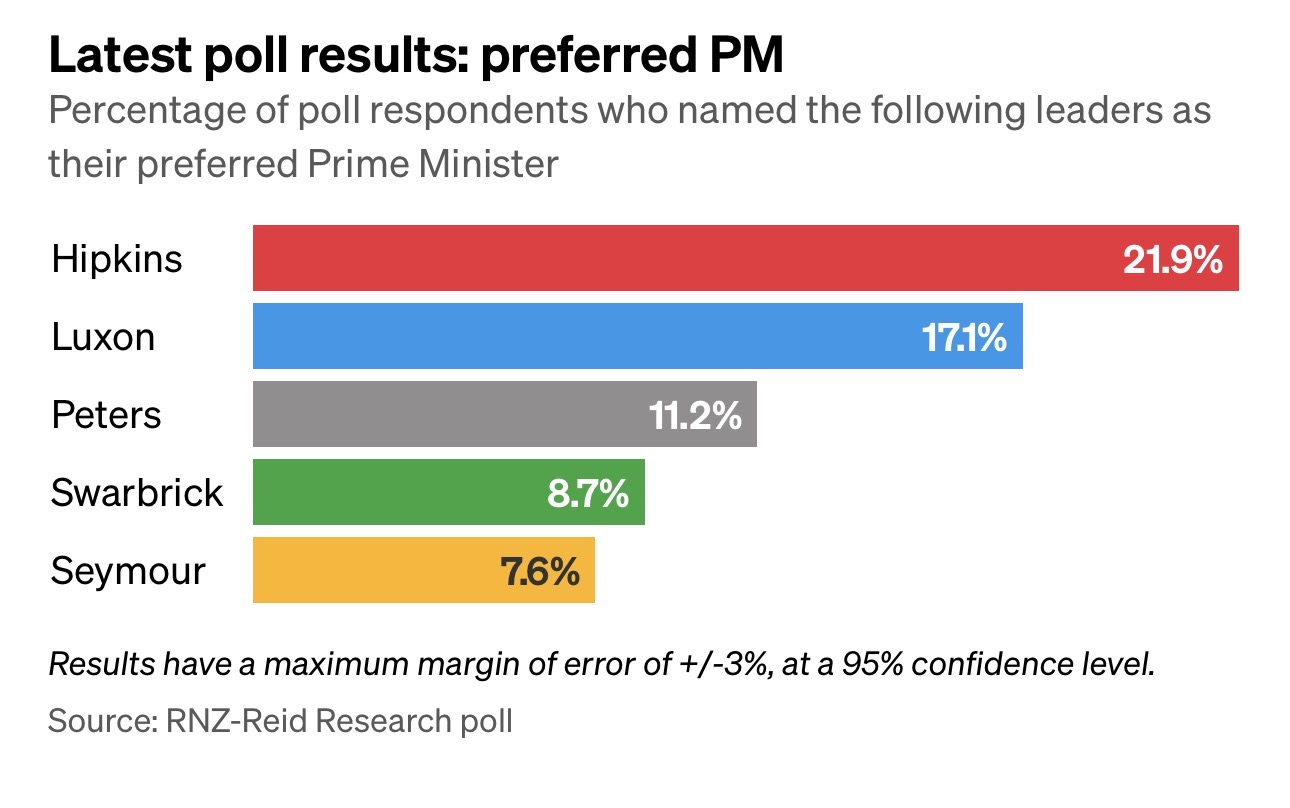
Luxon has also taken a hit on the preferred prime minister rating, falling to 17.1 percent, once again lagging behind Labour leader Chris Hipkins on 21.9 percent. Brown repeated that it would be a close election, and said ultimately the party vote was what mattered most.
Despite Labour suffering a third consecutive fall, Hipkins was confident New Zealanders wanted change. “There's a lot of energy and momentum behind Labour's campaign following our campaign launch,” he said, citing positive feedback about its policies designed to deliver cost of living relief. “Labour's willing to go and fight for New Zealanders to get a better deal, to tackle the cost of living, to get Kiwis back to work. Those messages are really resonating around the community.”
On these numbers, Hipkins could put Opportunity in a potential coalition alongside the Greens in place of Te Pāti Māori. “Really, that's up to voters,” he said. Of remaining the country's preferred prime minister, he added: “It's very hard to stay popular as leader of the Opposition … as we're out on the campaign trail, I'm sure we can build on that.”
The Green Party's co-leaders did not appear particularly surprised it climbed to nearly 15 percent. “The polls are reflecting what we are hearing on the ground, on the phones, on the doors, in community,” Marama Davidson said, adding that people believed the Greens would push down their bills and protect the environment.
Chlöe Swarbrick said the party would not take the result for granted. “We are on the ground doing the hard work, not only putting forward evidence-based solutions as we always have, but building trust in communities.” Swarbrick came in fourth as preferred prime minister at 8.7 percent, behind Hipkins, Luxon and Winston Peters, but brushed it off: “The Greens believe very foundationally that no one person is bigger than the kaupapa.”
Opportunity remains kingmaker at 5.5 percent, and leader Qiulae Wong said it was clear what voters were after. “We will bring stability so that no matter whether it's a Labour-led or a National-led government, we will be working to find common ground across the political spectrum,” she said, adding the party's bottom lines — laid out during the polling period — had struck the right balance between transformational and realistic.
ACT also had cause for celebration, climbing 1.3 points to 9 percent. Leader David Seymour said he was grateful for the support and encouraged by the growth. “But a week is a long time in politics and there's four of them to go,” he said. Seymour ranked fifth in the preferred prime minister stakes at 7.6 percent: “It just reminds me to bring my best self to the campaign every day.”
The leaders of Te Pāti Māori (down one point to 2 percent) and New Zealand First (down 1.3 points to 10.6 percent) did not make themselves available for an interview, though Winston Peters said his party would turn the poll into confetti.
Reid Research surveyed 1000 eligible voters online between 24 September and 1 October 2026, with a maximum margin of error of plus or minus 3.1 percentage points. Party-vote figures excluded the 3 percent who were undecided or did not know and the 2.6 percent who said they would not vote.
This article is republished from RNZ under its Creative Commons licence CC BY-ND 4.0. The original story was written by Lauren Crimp and first appeared on rnz.co.nz on 6 October 2026.
Have a story tip or spotted an error? Contact the newsroom.
6 October 2026 · 3 min read
6 October 2026 · 3 min read